
Always On: How Our Phones Are Changing the Way We Live

Think about the last time you had a few minutes with absolutely nothing to do. Maybe you were waiting for an appointment, sitting in the carpool line, standing in line for coffee, or waiting for a friend to arrive.
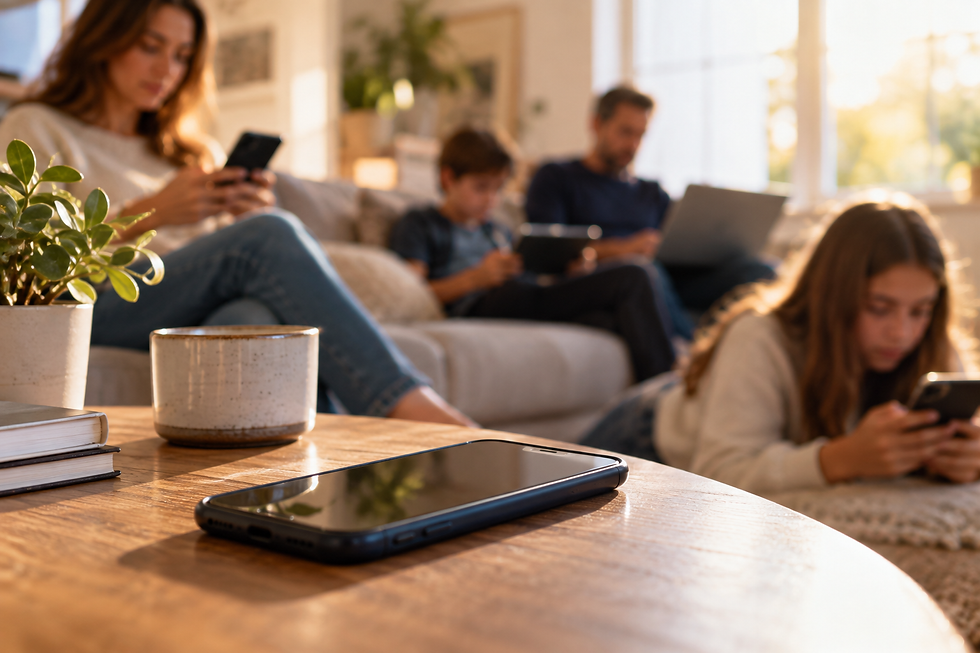
What did you do?
For many of us, the answer is automatic: we reached for our phone.
Sometimes there is a reason. We answer a text, check an email, look at the calendar, order groceries, pay a bill, or respond to a school notification. Other times, we open our phones without really knowing why. We check social media, close it, check our email, close that, and somehow find ourselves back on social media a few minutes later.
Our phones are incredibly useful. They help us work, communicate, navigate, organize our families, maintain friendships, and accomplish things that once required considerably more time and effort.
But that convenience has also created something relatively new: we rarely have to be completely unavailable anymore. And our brains and bodies are feeling the impact of this.
Being Reachable Has Become Being Available
There was a time when leaving work meant actually leaving work. If someone called your house and you weren't home, they simply couldn't reach you. If you were standing in line at the grocery store, you stood in line. If you wondered about something, you might have to wait until later to find the answer.
Today, almost everything follows us everywhere.
Work email is in our pocket. Friends and family can reach us at any moment. School apps send notifications. News alerts appear throughout the day. Social media is always waiting. Even our calendars, shopping lists, banking, photos, entertainment, and reminders live on the same device.
Being accessible is convenient. But accessibility can easily turn into a feeling that we should always be available.
A message arrives, and we feel the urge to answer it. An email comes in, and we think we should handle it while we're thinking about it. We remember something we need to buy and immediately order it.
Individually, these moments seem insignificant. Collectively, they can make it difficult to ever feel truly finished.
Productivity Can Keep Us from Resting
Not all excessive phone use looks like scrolling social media for hours. Sometimes it looks remarkably productive.
We answer emails from the couch. Schedule appointments while watching television. Check tomorrow's calendar before bed. Respond to a work message while making dinner. Order household supplies while waiting at a child's practice.
We are getting things done, which makes it harder to recognize that our brains may never really get a break.
Our phones haven't just made it possible to be productive almost anywhere, they have made it possible to be productive almost all the time. And when we know we could be accomplishing something, it can start to feel like we should be.
A few minutes waiting in the car becomes time to answer emails. Sitting on the couch becomes an opportunity to order groceries or check the calendar. A quiet evening can quickly turn into catching up on all the things we didn't get to during the day.
Over time, we can become uncomfortable with time that isn't being used "well." Rest can feel unproductive. Boredom can feel wasteful. Sitting still when there are unanswered emails, appointments to schedule, or items on the to-do list can even create a sense of guilt.
Being capable of doing something doesn't mean every available moment needs to be used. Rest isn't necessarily doing nothing for an entire afternoon. Sometimes rest is simply allowing the brain to have a few moments when it isn't processing new information, solving a problem, responding to someone, or deciding what needs to happen next.
There is value in accomplishing things. There is also value in having moments that accomplish absolutely nothing.
The Automatic Reach
Phones also give us an immediate escape from something humans historically experienced much more often: boredom.
A quiet elevator ride. Five minutes before a meeting. Sitting alone at a restaurant. Waiting for the kids to come out of school.
These small pauses used to be filled with observation, daydreaming, thinking, or simply waiting. Now they can be filled instantly.
And eventually, reaching for the phone can become less of a conscious decision and more of a reflex. We may reach for it when we are bored, but also when we are anxious, uncomfortable, overwhelmed, lonely, or trying to avoid a task. The phone gives our brain something else to focus on.
It can be helpful to notice when we are choosing to use our phones, and when we are simply reaching for it without even thinking or without a specific purpose in mind.
Our Attention Is Constantly Being Interrupted
One of the challenges of modern phone use isn't just the amount of time we spend looking at a screen. It's the frequency with which our attention shifts toward it.
You can be working and notice a notification, talking with your spouse and glance at a text, watching your child's game and check an email, or watching a movie and scrolling social media at the same time.
None of these moments seems particularly significant by themselves, but over the course of a day, our attention can become divided into hundreds of tiny pieces. We may technically be present for an experience without giving it our full attention. And constantly switching between tasks can leave us feeling mentally exhausted, even on days when it seems like we haven't done that much.
Connected All the Time, Present Less Often
There is an interesting contradiction in our relationship with phones: we can be more connected to people than ever while simultaneously being less present with the people around us.
We can maintain friendships across the country, share pictures with family members instantly, and communicate throughout the day. Those are meaningful benefits of having a phone.
But our phones can also pull our attention away from the conversations, relationships, and experiences happening directly in front of us. Most of us have probably experienced both sides of this. We have felt ignored by someone looking at their phone, and we have caught ourselves doing exactly the same thing.
The goal doesn't have to be eliminating phones from our relationships. It may simply be becoming more intentional about when we allow them to interrupt.
Creating Space Without Giving Up Your Phone
The solution probably isn't throwing away your smartphone or committing to an unrealistic digital detox. Phones are a part of modern life, and they offer tremendous benefits.
Instead, it may be more helpful to create small places or times in your life where your phone doesn't automatically get your attention.
It might look like the following:
Leaving your phone in another room during dinner
Turning off notifications that aren't actually important
Waiting ten minutes before checking your phone in the morning
Keeping work email off-limits during certain hours
Driving without immediately filling the silence with content
Occasionally standing in line and simply...standing in line
The goal isn't to create rigid rules or make yourself feel guilty every time you scroll Instagram. It is about rebuilding the ability to choose where your attention goes.
A Different Question About Screen Time
We often ask ourselves how much time we are spending on our phones. That is useful information, but it may not tell the whole story.
You might spend several hours on your phone because you are working, navigating, talking to someone you love, listening to music, or managing your family's schedule. The number alone doesn't tell us whether technology is helping or interfering with our lives.
Maybe a more useful question is: When am I actually unavailable to my phone?
When does your brain get to wander?
When do you give another person your full attention?
When can a message arrive without needing an immediate response?
When do you allow yourself to be bored?
And when do you rest without simultaneously trying to accomplish something?
Our phones aren't inherently the problem. They are useful tools, but tools work best when we are the ones deciding when to use them. Sometimes, the healthiest thing we can do isn't dramatically reducing our screen time, but simply creating a little more space where we aren't always on.
What This Means for Children and Teenagers
Adults aren't the only ones learning to live in a world where there is always something available to capture our attention. Children and teenagers are growing up in it.
For many kids, boredom can be solved almost instantly with a video, game, text, or scroll. Social interactions continue long after they leave school. Notifications can follow them into homework, family time, and bedtime. And because their brains are still developing skills related to attention, impulse control, emotional regulation, and decision-making, learning how to manage technology is an important developmental skill.
This doesn't mean screens are inherently harmful. Phones and other devices can provide connection, entertainment, creativity, information, and independence. The goal is not necessarily to eliminate technology, but to help children develop the ability to use it without feeling like they need constant stimulation.
Children still need opportunities to experience boredom, tolerate waiting, sustain attention, entertain themselves, and be fully present with other people. They also need periods of time when their brains are not continually taking in new information.
Teenagers face an additional challenge. Their social world often lives partly on their phones. Asking a teenager to put away a phone may not feel to them like simply turning off a device. It can feel like stepping away from conversations, plans, friendships, and what everyone else is doing. Recognizing this can help parents set healthy boundaries without dismissing how meaningful digital connection can be for adolescents.
Perhaps most importantly, children learn a great deal about technology by watching us. If we answer every notification during dinner, check email throughout the evening, or automatically reach for our phones whenever there is a quiet moment, they notice. Creating healthier technology habits for children often starts with looking at the habits we are modeling ourselves.
Start Small: Practical Ways to Be a Little Less “On”
Changing our relationship with our phones doesn't have to mean deleting every app, setting strict limits around screen-time, or becoming unreachable. It can start with noticing and then making a few small changes that create more space in the day.
Try choosing one or two of these rather than attempting to change everything at once:
Create a few phone-free anchors in the day. Dinner, the first 10 minutes after everyone gets home, bedtime routines, or driving to school can become predictable times when phones aren't competing for attention.
Make notifications earn their place. Turn off alerts for apps that don't actually require your immediate attention. Not everything needs permission to interrupt you.
Add a little friction. Move distracting apps off your home screen, keep your phone across the room while working, or charge it somewhere other than beside your bed.
Practice waiting without entertainment. Choose one ordinary moment (a grocery store line, carpool pickup, an elevator ride, or waiting in the doctor’s office) and resist automatically reaching for your phone.
Separate work from availability. If possible, decide when you are finished checking work email or messages for the day rather than allowing them to follow you throughout the evening.
Try doing one thing at a time. Watch the show without scrolling. Talk to your child without checking a notification. Walk the dog without listening to anything occasionally. Give your brain fewer things to process at once.
Pause before picking up your phone. Ask yourself, What am I picking this up to do? Sometimes there is a clear answer. Other times, you may realize there wasn't actually a reason.
Let boredom happen, especially for kids. You don't have to immediately solve every "I'm bored." Unstructured time gives children an opportunity to figure out what to do next.
Create family norms instead of only rules for kids. "Phones stay off the table during dinner" often works better than "You need to put your phone away while the adults keep theirs nearby."
Protect sleep. Consider a family charging spot outside bedrooms or a time when phones are put away for the night. For teenagers who use their phones as alarms, an inexpensive alarm clock can remove one reason the phone needs to stay beside the bed.
Talk about what phones are doing for us. Instead of focusing only on screen-time totals, ask: Does this help me feel connected or leave me feeling worse? Am I choosing to do this, or am I doing it automatically? What am I giving up when I'm on my phone right now?
You don't need to do all of these. In fact, trying to overhaul your family's relationship with technology overnight will probably feel frustrating.
Instead, pick one small experiment. Leave phones away during dinner for a week. Turn off three unnecessary notifications. Don't check email after a certain time. Let the kids be bored on a short car ride. Put your phone down when someone starts telling you a story.
Notice what happens.
The goal isn't to use our phones perfectly. It is to make sure that, in a world designed to keep us constantly connected and productive, we are still making room to disconnect, be present, and let our minds rest.
And sometimes, putting the phone down isn't about missing what's happening online. It is about making sure we don't miss what's happening right in front of us.


